Renting vs Buying in Knoxville, TN: What Makes Sense Right Now
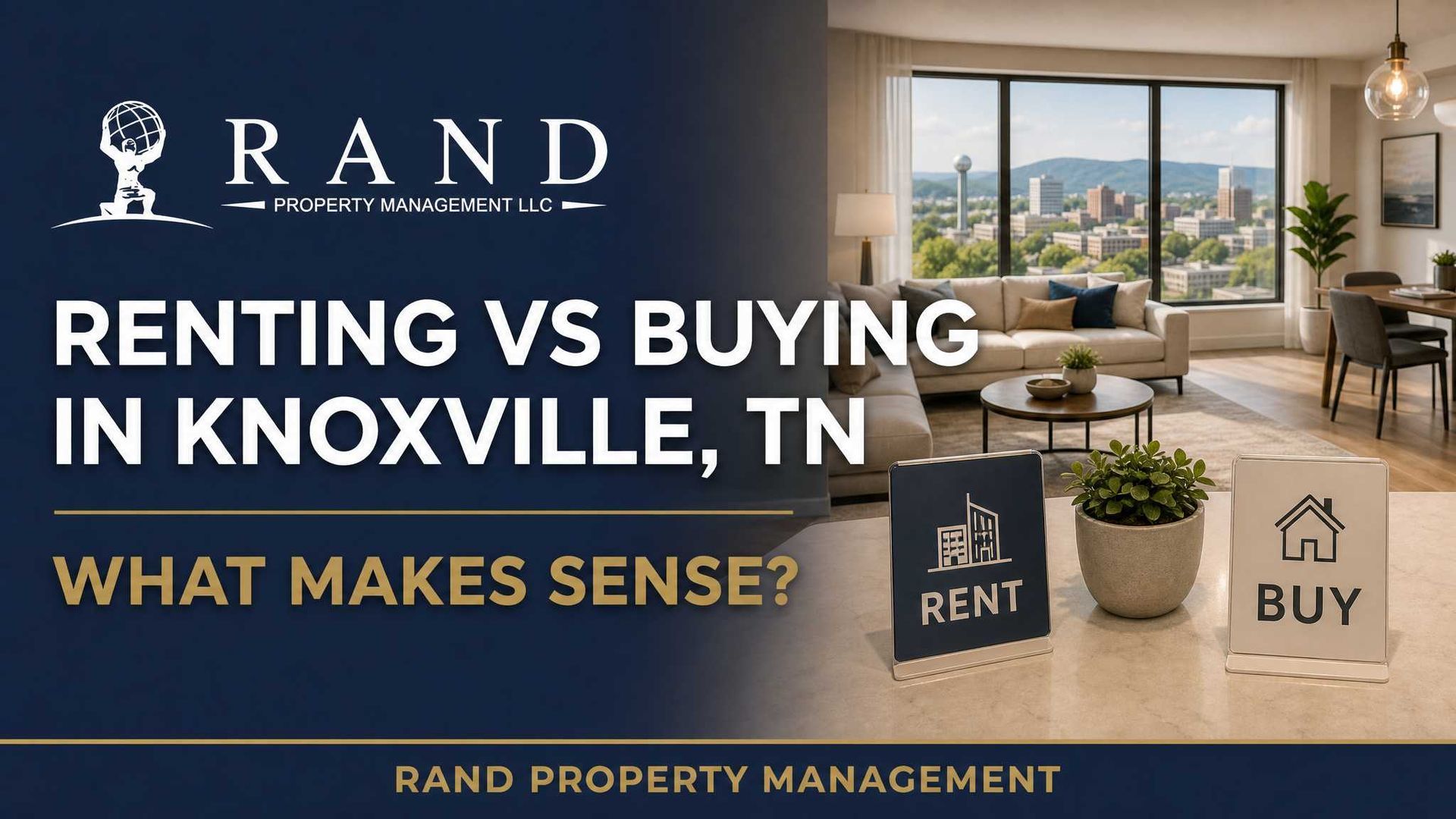
In Knoxville, TN, renting makes more financial sense than buying for most people in 2025 — particularly for those with fewer than three to five years of planned residency, uncertain employment situations, or limited down payment savings. The Knoxville housing market has seen significant price appreciation over the past four years, and mortgage rates at current levels make monthly ownership costs meaningfully higher than equivalent renting costs for comparable square footage in most neighborhoods. That said, buying makes sense for long-term Knoxville residents with stable income, strong credit, and a genuine commitment to a neighborhood. This guide gives you an honest framework for making the decision — without defaulting to the conventional wisdom that buying is always better.
The renting versus buying debate in Knoxville, TN has shifted significantly over the past few years. In 2019, the calculus was relatively straightforward — Knoxville's housing prices were low enough, and mortgage rates favorable enough, that buying looked compelling for almost anyone with stable employment and a down payment. In 2025, the picture is more nuanced. Home prices in Knoxville have risen substantially.
Mortgage rates have remained elevated compared to the historic lows of 2020 and 2021. And the flexibility value of renting — long underweighted in the renting-vs-buying conversation — has become more apparent as the labor market has shifted toward remote work and career mobility.
This is not a guide that will tell you buying is always better or renting is always smarter. It is a guide that will give you the specific financial and lifestyle framework to make the right decision for your situation in Knoxville right now.
The Financial Basics — What Renting and Buying Actually Cost in Knoxville
Before any lifestyle consideration, the decision starts with an honest accounting of what renting versus buying actually costs in Knoxville's current market.
The Renting Cost Picture
In Knoxville, a 2 bedroom apartment rents for approximately $1,100 to $1,500 per month depending on neighborhood, community quality, and included amenities. A 3 bedroom apartment runs $1,200 to $1,800 per month. These figures include on-site parking, appliances, and maintenance in communities like those managed by Rand Property Management — meaning the monthly rent is close to the all-in monthly housing cost, with utilities as the primary variable outside of it.
The Buying Cost Picture
The median home price in Knoxville has risen to approximately $280,000 to $320,000 for a modest 3 bedroom home in an established neighborhood, with desirable West Knoxville areas and newer construction running $350,000 to $500,000 and above. At current 30-year mortgage rates — which have remained in the 6.5 to 7.5 percent range through much of 2024 and into 2025 — a $300,000 home with a 10 percent down payment produces a monthly mortgage payment of approximately $1,860 to $1,980 before property taxes, homeowner's insurance, and HOA fees where applicable.
Adding property taxes at Knox County's effective rate of approximately 0.45 to 0.55 percent of assessed value — roughly $1,350 to $1,650 annually on a $300,000 home, or $112 to $137 per month — and homeowner's insurance at approximately $100 to $150 per month, the all-in monthly cost of owning a $300,000 Knoxville home with 10 percent down runs approximately $2,072 to $2,267 per month before maintenance costs.
The average annual home maintenance cost — plumbing repairs, HVAC servicing, appliance replacement, exterior maintenance — runs one to two percent of home value per year. On a $300,000 Knoxville home, that is $3,000 to $6,000 annually, or $250 to $500 per month that renting eliminates entirely by transferring maintenance responsibility to the property manager.
The honest all-in monthly cost of owning a $300,000 Knoxville home is approximately $2,300 to $2,750 per month in 2025. A comparable 3 bedroom rental through a well-managed community runs $1,200 to $1,800 per month. The renting cost advantage in Knoxville's current market is $500 to $1,000 per month for comparable living space — a meaningful gap that the equity-building argument for buying needs to overcome to justify the ownership premium.
The Equity Argument — Honest and Complete
The most powerful argument for buying in Knoxville is equity accumulation — the gradual transfer of your monthly housing payment from pure expense to ownership stake. This argument is real and deserves honest treatment rather than dismissal.
When you pay rent, every dollar goes to the landlord and does not accumulate as personal wealth. When you pay a mortgage, a portion of each payment — increasing over time as the loan amortizes — reduces your principal balance and builds equity in an asset you own. In Knoxville's market, where home values have appreciated at an average rate of 6 to 8 percent annually over the past five years, a homeowner who purchased in 2020 has seen substantial equity growth on top of principal paydown.
The counterargument is that the equity-building advantage of ownership requires time and a stable housing market to realize. A Knoxville homeowner who buys at $300,000, pays $2,500 per month in all-in ownership costs for two years, and then sells faces transaction costs — realtor commissions, closing costs, staging, and moving expenses — that typically run 8 to 10 percent of sale price, or $24,000 to $30,000 on a $300,000 home. If the home has not appreciated enough to cover those transaction costs plus the ownership premium paid over renting during the holding period, the renter who invested the monthly cost difference — $500 to $1,000 per month into a diversified investment account — may come out financially ahead over the same period.
The equity argument for buying in Knoxville becomes compelling when the holding period extends to five years or more, the down payment is substantial enough to produce a manageable monthly payment, and the property is in a neighborhood with sustained appreciation trajectory. It becomes less compelling for shorter holding periods, lower down payments at current mortgage rates, and properties in markets where appreciation has already priced in significant future growth.
The Flexibility Value of Renting — Often Underestimated
The flexibility value of renting is the most consistently underweighted factor in the renting-vs-buying decision — particularly in Knoxville's current labor market context.
Renting a Rand Property Management apartment in Knoxville gives you the ability to relocate within 30 to 60 days notice. If your employer offers a better position in a different market, you take it. If your life circumstances change — a relationship, a family situation, a health consideration — you move when you need to rather than when you can sell a house. If you discover that the neighborhood you chose is not the right fit — the commute is longer than the map suggested, the community character differs from the tour impression, the noise level is higher than expected — you course-correct at lease renewal rather than carrying a property.
This flexibility has a dollar value that is difficult to assign precisely but becomes concrete in moments of life change. In Knoxville's current market, where the inventory of homes for sale is tighter than historical averages and selling timelines are less predictable than in the seller's market of 2020 to 2022, the inability to move quickly when circumstances require it carries real cost and real stress.
For renters who are relatively new to Knoxville — within one to three years of arrival, whether through relocation, employment, or lifestyle choice — the flexibility argument for renting is particularly strong. Understanding which Knoxville neighborhood is genuinely the right fit for your daily life takes lived experience rather than research, and renting provides the opportunity to develop that understanding before committing to a neighborhood through ownership.
When Renting Is the Right Answer in Knoxville
Renting makes clear financial and lifestyle sense in Knoxville when your planned residency is under three years. The transaction cost of buying and selling within a three-year window, combined with the current ownership premium over renting, makes the ownership path financially disadvantageous for most buyers at this time horizon regardless of how the equity math is framed.
Renting also makes sense when your income or employment situation is in transition. The mortgage qualification process in 2025 is rigorous — lenders require stable employment history, strong credit, and documented income. If you have changed jobs in the past year, are self-employed with variable income, or are new to the workforce, renting while building the financial profile that mortgage qualification requires is a practical path rather than a compromise.
Renting makes sense when your down payment savings are below 10 percent of your target home price. At Knoxville's current price levels, a 10 percent down payment on a $300,000 home is $30,000 — a meaningful savings threshold that takes time to reach for most renters. Buying with less than 10 percent down triggers private mortgage insurance, which adds $100 to $200 per month to the ownership cost and further narrows the equity-building advantage over renting.
Renting makes sense when you are new to Knoxville and still learning the market. The difference in daily life between West Knoxville, North Knoxville, South Knoxville, and the surrounding communities — Powell, Farragut, Halls, Corryton — is not fully apparent until you've lived here long enough to experience commute realities, neighborhood character across seasons, and the specific amenities and friction points of each area. A rental lease gives you the time to learn before you commit.
When Buying Is the Right Answer in Knoxville
Buying makes compelling sense in Knoxville when you have a five-plus year commitment to the market, stable employment with strong income documentation, a down payment of 10 to 20 percent, and a clear sense of which neighborhood is the right fit for your long-term life.
If you are raising children in Knoxville and your school district matters — Knox County Schools has meaningful variation in performance by zone — homeownership gives you the ability to lock into a specific address and school assignment in a way that renting does not guarantee. Annual rental turnover and community availability constraints can move renters between zones in ways that disrupt children's school continuity.
If you are planning significant life investment in Knoxville — building a career, establishing a business, growing a family network — the stability of homeownership aligns with that investment in ways that renting, with its annual lease renewals and market-driven rent adjustments, does not.
If you are financially positioned to put 20 percent down on a Knoxville home — eliminating private mortgage insurance and producing a more manageable monthly payment — the ownership economics become significantly more favorable. A 20 percent down payment on a $300,000 Knoxville home reduces the monthly mortgage to approximately $1,640 to $1,740, narrowing the gap with all-in rental costs to a level where the
equity accumulation argument becomes more persuasive.
The Knoxville Market Context for 2025
Understanding Knoxville's housing market trajectory informs the buying decision in ways that general rent-vs-buy frameworks do not capture.
Knoxville has experienced significant home price appreciation since 2020, driven by in-migration from higher-cost markets, limited housing inventory, and the broader Southeast growth dynamic. Median prices that were $200,000 to $220,000 in early 2020 have risen to $280,000 to $320,000 in established neighborhoods. New construction in Farragut, Powell, and the western suburbs pushes $400,000 to $600,000 for production-built homes with modern finishes.
Whether this appreciation continues at the same rate is a question no market analyst can answer with certainty. Knoxville's fundamentals — population growth, University of Tennessee institutional anchor, diversified employment base, quality of life positioning relative to Nashville and Asheville — support continued demand. But markets that have appreciated 40 to 50 percent in four years carry reversion risk that markets earlier in their appreciation cycle do not.
For renters in Knoxville's current market, the uncertainty about near-term price appreciation is an additional argument for patience. Renting while the market finds its equilibrium — watching whether the appreciation of the past four years sustains, moderates, or partially corrects — preserves the option to buy at a clearer point in the cycle without foreclosing it.
Rand Property Management — The Renting Side of the Equation, Done Right
If you have read through the analysis above and concluded that renting is the right decision for your Knoxville situation right now, the quality of the rental experience you choose matters significantly to how you will feel about that decision over the course of a lease.
The difference between renting from a professionally managed, resident-first company like Rand Property Management and renting from a less attentive landlord is the difference between a living situation that feels stable and well-supported and one that introduces ongoing friction — slow maintenance responses, unclear communication, community neglect — that makes the ownership alternative look better than it might otherwise.
Rand operates communities across Knoxville, Maryville, Jefferson City, Morristown, Louisville, Alcoa, and Powell. Every community includes 24/7 on-call emergency maintenance, on-site off-street parking, a full appliance package, pet-friendly policies, and coin laundry in every building. These are the features that make renting not just financially sensible but genuinely comfortable — a home rather than a placeholder while you wait to become a buyer.
Visit randpropertymanagement.com/community-directory to browse current availability across East Tennessee and find the community that matches your Knoxville life right now.
Frequently Asked Questions — Renting vs Buying in Knoxville, TN
Is it cheaper to rent or buy in Knoxville, TN right now?
In 2025, renting is cheaper on a monthly basis for most configurations in Knoxville. A 3 bedroom apartment through a well-managed community runs $1,200 to $1,800 per month all-in. The comparable all-in ownership cost for a $300,000 Knoxville home — mortgage, taxes, insurance, and maintenance — runs $2,300 to $2,750 per month. The monthly renting advantage of $500 to $1,000 requires the equity-building benefit of ownership to overcome over a multi-year holding period.
How long should I plan to stay in Knoxville before buying makes sense?
Most financial analysts use a three-to-five-year rule — if your planned residency is under three years, renting almost always wins the financial comparison. If you plan to be in Knoxville for five years or more with stable employment and strong financial positioning, buying becomes competitive depending on your down payment, mortgage rate, and target neighborhood.
What is the median home price in Knoxville, TN in 2025?
Median home prices in established Knoxville neighborhoods range from approximately $280,000 to $320,000. West Knoxville and Farragut command $350,000 to $500,000 for typical family homes. North Knoxville and South Knoxville offer entry points in the $240,000 to $290,000 range. New construction throughout the metro area generally starts at $350,000 and climbs significantly from there.
Can I rent in Knoxville while saving for a down payment?
Yes — and for many Knoxville renters, this is the most financially sound path. Renting in a well-managed community while building toward a 10 to 20 percent down payment keeps monthly housing costs manageable, avoids private mortgage insurance, and preserves flexibility during the savings period. Rand Property Management communities offer competitive pricing across the Knoxville market with the stability and management quality that makes multi-year renting a comfortable strategy rather than a temporary compromise.
Does renting in Knoxville build any equity?
Renting does not build equity in a property. However, the monthly savings compared to ownership can be invested in ways that build wealth — a point that home-ownership advocates often overlook. At $700 per month invested consistently over five years at a seven percent average annual return, a Knoxville renter accumulates approximately $50,000 — a figure competitive with the equity built through principal paydown on a $300,000 mortgage over the same period at current rates.
Is Knoxville's housing market expected to keep appreciating?
No one can answer this with certainty. Knoxville's fundamentals — population growth, UT institutional anchor, quality of life relative to higher-cost markets — support continued demand. However, the pace of appreciation seen from 2020 to 2024 is historically unusual and carries reversion risk. Renters who are uncertain about the near-term price trajectory benefit from the flexibility to enter the ownership market at a clearer point in the cycle.