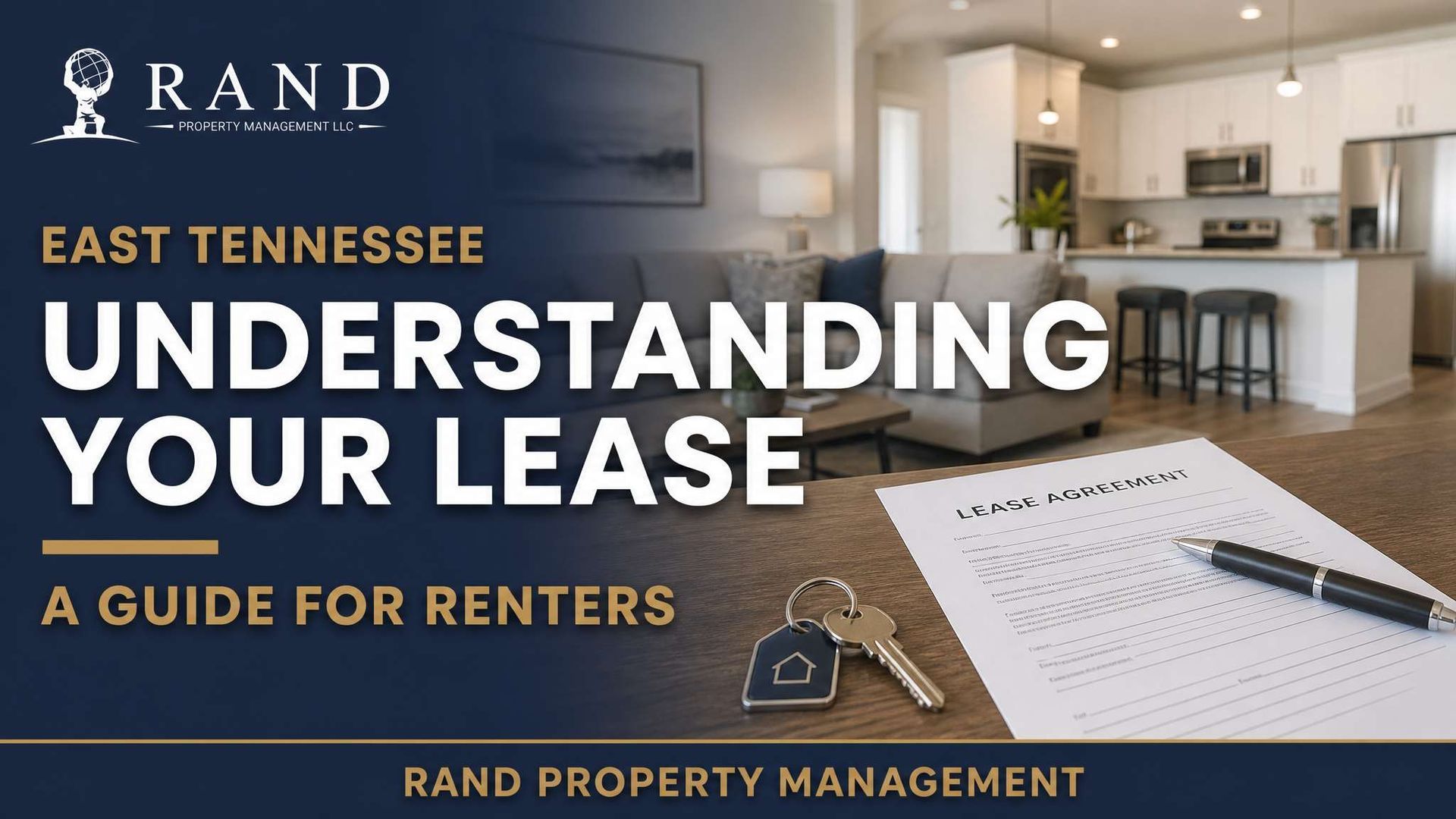
Understanding Your Lease Agreement: A Complete Guide for East Tennessee Renters
Quick Answer
A lease agreement is a legally binding contract between a renter and a landlord that governs every aspect of the tenancy — rent amount and due date, lease term, security deposit conditions, maintenance responsibilities, pet policy, move-out requirements, and more.
In East Tennessee, leases are governed by the Tennessee Uniform Residential Landlord and Tenant Act, which establishes specific rights and responsibilities for both parties. Before signing any lease in Knoxville, Maryville, Jefferson City, Morristown, or anywhere across East Tennessee, every renter should understand what each major clause means, which sections carry the most financial risk if misunderstood, and what questions to ask the property manager before putting pen to paper.
Rand Property Management’s leasing teams across East Tennessee are trained to walk renters through every section of the lease clearly — but this guide gives you the independent knowledge to engage that conversation with full confidence.
Most renters sign their lease the way most people accept software terms of service — scrolling to the bottom and clicking agree without reading what they are agreeing to. The parallel ends there. A software terms of service you ignore costs you nothing in practice. A lease clause you ignore can cost you your security deposit, expose you to early termination fees, leave you financially responsible for repairs you assumed the landlord would cover, or lock you into renewal terms you did not anticipate.
The lease agreement is the most important document in your rental relationship. It predates every conversation you will have with your property manager, supersedes every verbal assurance made during the tour, and governs every dispute that arises during the tenancy.
Understanding it before you sign it is not a legal technicality — it is the practical foundation of a tenancy that goes smoothly rather than one that becomes a source of ongoing confusion, financial surprises, and conflict.
This guide covers every major section of a standard East Tennessee residential lease agreement — what it says, what it means for your daily life and your finances, which parts carry the most risk if misunderstood, and what to ask before you sign. It is written for renters at every experience level in every East Tennessee market — Knoxville, Maryville,
Jefferson City, Morristown, Alcoa, Louisville, Powell, and beyond.
The Legal Framework: Tennessee’s Residential Landlord and Tenant Act
Before the specific clauses, the legal context matters — because Tennessee law establishes a baseline of rights and responsibilities that apply to every residential lease in the state, regardless of what any individual lease says.
The Tennessee Uniform Residential Landlord and Tenant Act — commonly abbreviated URLTA — governs residential rental relationships in Tennessee counties and cities that have adopted it. Knox County, where Knoxville sits, has adopted the URLTA. Blount County, covering Maryville and Alcoa, has adopted it. Hamblen County, covering Morristown, has adopted it. Jefferson County has adopted it. For renters in these markets, the URLTA provides a statutory framework that establishes minimum landlord obligations, maximum security deposit limits, required notice periods, and tenant remedies that cannot be waived even in a signed lease.
The most practically significant URLTA provisions for East Tennessee renters include the following. A landlord must maintain the rental unit in a habitable condition — functional plumbing, heating, electrical systems, and structural integrity are legally required regardless of what the lease says. A landlord must return a security deposit within 30 days of the end of the tenancy along with an itemized statement of any deductions — failure to do so within this window creates tenant remedies including the right to recover the full deposit plus damages. A landlord must provide at least 24 hours advance notice before entering a rental unit for non-emergency purposes.
A tenant has the right to terminate a lease without penalty in specific circumstances — active military service, domestic violence situations, and landlord failure to maintain habitable conditions are among the statutory grounds.
Knowing this framework before you read your lease gives you the context to evaluate whether any lease clause attempts to waive statutory rights that Tennessee law does not allow landlords to waive — and to identify provisions that are unenforceable regardless of whether they appear in a signed document.
Section One: The Parties and the Property
Every lease begins with identification of the parties — the landlord or property management company and the tenants — and the specific property being leased. This section is typically brief and administrative, but it establishes several important baseline facts that the rest of the lease depends on.
Who Is the Landlord
The lease should identify the legal entity that is the landlord — for Rand Property Management communities, this will typically be the specific LLC or ownership entity that holds the property, with Rand Property Management identified as the management agent.
This distinction matters for two reasons. Notices, complaints, and legal communications should be directed to the correct entity. And understanding whether you are dealing with an individual landlord or a professional management company tells you something important about the accountability structure and operational standards you will experience during the tenancy.
Who Is on the Lease
Every adult who will live in the apartment should be named on the lease — not because it is a formality but because the lease creates the legal relationship between the occupant and the landlord. An adult occupant who is not on the lease has no legal standing under the lease agreement and no direct rights under the URLTA as they apply to that tenancy. If you are moving in with a partner, a roommate, or a co-occupant, confirm that all adults are named on the lease before signing.
The Property Description
The lease should identify the specific unit — building number, unit number, and address — being leased. Confirm that this matches the unit you toured and intend to occupy. This sounds obvious but occasionally matters in larger communities where unit numbers are similar and administrative errors occur.
Section Two: The Lease Term
The lease term clause defines the period of the tenancy — the start date, the end date, and the conditions under which the lease continues or terminates at the end of the period.
Fixed-Term vs. Month-to-Month
Most initial Knoxville and East Tennessee apartment leases are fixed-term — typically 12 months, though 6-month and lease-to-lease arrangements exist. A fixed-term lease gives both parties certainty: the rent is fixed for the term, the tenant has guaranteed housing for the term, and neither party can unilaterally change the relationship mid-term without consequence.
A month-to-month tenancy — which may be the initial arrangement or the arrangement that begins after a fixed term expires without a new lease being signed — provides flexibility at the cost of certainty. Either party can typically terminate a month-to-month tenancy with 30 days written notice, and the landlord can adjust rent with the same notice period.
Auto-Renewal Provisions
Many East Tennessee leases include an auto-renewal or holdover clause — a provision that specifies what happens if the lease end date passes without either party taking action. The two most common outcomes are automatic renewal for another fixed term at the current or adjusted rent, or conversion to a month-to-month tenancy at a specified rate.
The auto-renewal clause is the one that most frequently catches first-time and inattentive renters by surprise. A renter who intends to move out at lease end but misses the required notice window discovers at or after the lease end date that they have automatically renewed for another year — or that they are now in a month-to-month arrangement at a higher rate than their fixed-term rent. Record your lease end date and your required notice deadline in your phone calendar the day you sign the lease so this never happens.
Required Notice Period
The notice period clause specifies how much advance written notice you are required to give if you do not intend to renew your lease. In Tennessee, this is most commonly 30 to 60 days written notice before the lease end date — but the specific requirement in your lease governs, and leases vary. Read this clause specifically and confirm the exact notice requirement rather than assuming a standard 30-day window applies.
Section Three: Rent
The rent clause is the most fundamental financial term of the lease. It specifies not just the monthly amount but the conditions under which it is due, the consequences of late payment, and the mechanisms for adjustment.
Monthly Rent Amount and Due Date
The lease specifies the monthly rent amount and the date on which it is due each month — most commonly the first of the month. Confirm that the rent amount in the lease matches what you were quoted during the leasing process. Discrepancies between quoted and documented rent are rare at professionally managed communities like Rand’s but worth verifying on the document rather than assuming.
Grace Period and Late Fees
Most East Tennessee residential leases include a grace period — a defined number of days after the due date during which rent can be received without triggering a late fee. The grace period is commonly 3 to 5 days in the Knoxville market. Read this clause specifically and know your grace period precisely — assuming a longer grace period than the lease provides and missing the actual window triggers a late fee that the lease fully supports.
The late fee clause specifies the amount or percentage of monthly rent that constitutes the late fee. Tennessee law limits late fees in URLTA jurisdictions to no more than 10 percent of the rent amount due or $30, whichever is greater. A late fee clause that exceeds this limit is unenforceable under Tennessee law — but the most practical approach is to pay on time
rather than testing the enforceability of fee clauses.
Rent Adjustment at Renewal
Some leases specify a fixed rent for the lease term with no provision for mid-term adjustment — meaning your rent cannot change until the lease renews. Others include provisions for annual rent adjustments tied to market rate changes or CPI indexes. Read the rent adjustment section to understand whether your rent is fixed for the full term or subject to adjustment, and under what conditions.
At renewal, landlords in Tennessee are generally free to adjust rent to market rate with appropriate notice. The specific notice requirement for a rent increase at renewal is typically 30 days written notice. Professional management companies like Rand provide renewal communications well in advance of the lease end date, giving residents sufficient time to make an informed decision about renewal at any adjusted rate.
Section Four: Security Deposit
The security deposit clause is the lease section that most directly affects your finances at the end of the tenancy — and the one that generates the most disputes between renters and landlords in East Tennessee’s rental market.
The Amount
Security deposits for East Tennessee apartments are typically one to two months’ rent. Tennessee’s URLTA does not cap the security deposit amount — the lease specifies the amount, and the amount is what you pay. Confirm the deposit amount before signing and ask about any reduced deposit promotions that may be available. Many Rand communities offer move-in specials that include reduced deposit options for qualified applicants.
What the Deposit Covers
The security deposit clause will specify what the deposit can be applied toward at the end of the tenancy. The standard formulation covers unpaid rent, lease violations, and damages beyond normal wear and tear. Understanding the distinction between normal wear and tear — which the landlord is legally required to absorb — and damage — which the deposit can legitimately cover — is the most practically important security deposit concept a renter can understand.
Normal wear and tear in Tennessee is defined as deterioration that occurs through ordinary use over time. Small nail holes from picture hanging, minor scuffs on painted walls, carpet wear in traffic areas, and light fixture wear are all examples of normal wear and tear that cannot be charged against a security deposit. A large hole in the wall, pet-related damage to flooring or fixtures, burns on counters or carpet, and broken fixtures or hardware are examples of damage that legitimately justifies deposit deductions.
The move-in inspection you complete on day one — photographing every pre-existing condition and submitting the documentation to the leasing office — is the protection that ensures normal wear and pre-existing conditions are distinguished from actual tenancy damage. Without that documentation, a dispute over a scuff or a carpet stain has no clear resolution.
The Return Timeline
Under Tennessee’s URLTA, a landlord must return the security deposit — or the remaining balance after legitimate deductions — within 30 days of the end of the tenancy, accompanied by an itemized written statement of any deductions. Failure to return the deposit within this window, or failure to provide the itemized statement, gives the tenant specific legal remedies including the right to recover the full deposit regardless of any legitimate deductions, plus potential damages.
Know this timeline. When you move out, provide your forwarding address in writing so the landlord has no basis for a delayed return. If the deposit is not returned within 30 days, the Tennessee URLTA gives you a clear legal path — consult a tenant’s rights resource or legal aid if needed.
Non-Refundable Fees vs. Deposits
Some East Tennessee leases include non-refundable fees — for administrative processing, pet accommodation, or other purposes — that are distinct from the refundable security deposit. These are two different financial instruments and the lease should label them clearly. A non-refundable fee is gone at the end of the tenancy regardless of condition. A refundable deposit is returned minus legitimate deductions. Confirm which amounts in your move-in financial requirements are refundable and which are not.
Section Five: Maintenance and Repairs
The maintenance clause defines who is responsible for what in terms of property upkeep — a section that generates significant confusion when renters assume landlord responsibility for items that the lease assigns to tenants, or vice versa.
Landlord Obligations
Under Tennessee’s URLTA, landlords are legally required to maintain the rental unit in a habitable condition regardless of what the lease says. This means functional plumbing, heating, electrical systems, structural soundness, and compliance with applicable housing codes. These are non-waivable obligations — a lease clause that purports to transfer responsibility for these systems to the tenant is unenforceable in Tennessee.
At Rand communities, the landlord maintenance responsibility extends through the management company — Rand’s maintenance team, backed by 24/7 emergency coverage, handles the full range of building systems, appliances provided by the landlord, and infrastructure repairs that fall within the landlord’s legal obligation.
Tenant Obligations
Tenant maintenance obligations in a standard East Tennessee lease typically include keeping the unit clean, properly disposing of trash, not damaging the unit through negligence or misuse, promptly reporting maintenance issues to the landlord, and maintaining any tenant-owned appliances. The lease may also specify tenant responsibility for minor maintenance items — replacing light bulbs, for instance, or maintaining smoke detector batteries — that are routine tenant self-care rather than building system maintenance.
The Maintenance Request Process
The lease should describe or reference the maintenance request process — how to submit requests, what response timeline to expect for non-emergency items, and how to escalate unresolved issues. Understanding this process before you need it is the preparation that makes the first maintenance situation a smooth transaction rather than a frustrating discovery that the process requires a specific channel you didn’t know about.
For Rand communities, the maintenance request process is clearly communicated through the leasing team at move-in. The 24/7 emergency maintenance line is for urgent situations — plumbing failures, HVAC outages, electrical hazards, security issues. Non-emergency requests go through the standard maintenance channel, which the leasing team at move-in will walk you through specifically.
Emergency Maintenance
The lease should specify the process for emergency maintenance — the situations that constitute an emergency and the channel through which they are reported outside of business hours. At Rand communities, 24/7 emergency maintenance is a management standard that applies across the full East Tennessee portfolio — from Reserve at Bellwood in Morristown to Rocky View Apartment Homes in North Knoxville.
Read the emergency maintenance clause and save the emergency contact number in your phone on move-in day. The first emergency situation is not the moment to discover where this information is located in your lease.
Section Six: Rules and Restrictions
The rules and restrictions section — sometimes called community standards, lease addenda, or house rules — governs the behavioral and operational standards of daily tenancy. It is the section that most directly shapes your daily life in the community and the one that generates the most friction when renters discover limitations they were not aware of.
Quiet Hours
Virtually every multi-unit residential lease in East Tennessee includes a quiet hours provision — a defined time window during which residents are expected to limit noise to a level that does not disturb neighboring units. Quiet hours in the Knoxville market are commonly 10 PM to 8 AM on weekdays and 11 PM to 9 AM on weekends, though the specific hours in your lease govern. Know your quiet hours before your first weekend in the community.
Guest Policy
The guest policy clause defines the terms under which guests can stay in your unit — typically specifying a maximum consecutive stay length and total monthly stay limit for non-lease guests. The most common provision limits non-lease guests to 14 consecutive days or 30 total days within a 12-month period. A guest who exceeds these limits may be considered an unauthorized occupant under the lease.
This clause matters most in two situations. A partner or significant other who spends significant time at your apartment approaches the guest limit threshold over the course of a lease. A family member or friend who stays for an extended visit crosses it. Knowing the guest policy in advance allows you to manage these situations proactively — either by keeping guest stays within the defined limits or by having a conversation with the leasing office about the specific situation before it becomes a lease violation.
Pet Policy
If you have a pet or intend to get one during the tenancy, the pet policy clause is among the most important sections of your lease. It specifies which pets are permitted — species, breeds, and weight limits — what fees apply, whether those fees are refundable deposits or non-refundable charges, and the behavioral and care standards your pet must meet.
The pet policy at Rand communities covers dogs and cats and is generally one of the most accommodating in East Tennessee’s professionally managed rental market. The specific breed restrictions, weight limits, and fee structures vary by community — confirm these specifics with the leasing team before signing if you have a pet, and before acquiring one during the tenancy.
A pet that is not disclosed in the lease is an unauthorized pet — a lease violation that, if discovered, can result in a cure-or-quit notice requiring you to remove the pet or face lease termination. If you acquire a pet during your tenancy, inform the leasing office and update your lease documentation promptly rather than assuming the addition will go unnoticed.
Parking
The parking clause specifies your parking rights — whether parking is assigned or first-come-first-served, how many spaces your lease covers, and any restrictions on vehicle types, overnight parking, or commercial vehicle storage. At Rand communities, on-site off-street parking is included as a standard resident amenity — confirm the specific parking assignment and any applicable rules with the leasing team at move-in.
Smoking Policy
Most East Tennessee apartment communities — including all Rand communities — prohibit smoking inside the unit and in designated non-smoking areas. Smoking damage to walls, carpets, and fixtures is explicitly chargeable against the security deposit and is excluded from normal wear and tear definitions. If you smoke, understand the specific restrictions in your lease and the outdoor areas where smoking is permitted before signing.
Alterations Policy
The alterations clause defines what modifications you are and are not permitted to make to the unit — painting, installing shelving, mounting televisions, and other physical changes. Most East Tennessee leases permit small nail holes for picture hanging but prohibit painting, significant wall modifications, and structural changes without written landlord approval.
Confirm the alteration rules before making any physical changes to the unit — alterations made without permission are restorable at your expense and potentially chargeable against the security deposit.
Section Seven: Early Termination
The early termination clause governs what happens if you need to end your lease before the expiration date — a situation that first-time renters frequently underestimate the cost of.
Early Termination Fees
Most East Tennessee leases include an early termination fee — a specified financial penalty for ending the lease before the end of the fixed term. This is most commonly two months’ rent, though the specific amount in your lease governs. If you break a $1,200 per month lease with a two-month early termination fee, the fee is $2,400 in addition to any remaining rent obligations during the notice period.
Understanding the early termination fee before you sign gives you a clear picture of what flexibility — or inflexibility — the lease provides for life changes during the tenancy.
Employment relocations, family changes, and health circumstances are the most common reasons renters need to exit a lease early, and knowing the cost of that exit in advance is part of the informed financial commitment a lease represents.
Tennessee Statutory Early Termination Rights
Tennessee’s URLTA provides specific grounds for early lease termination without penalty that apply regardless of what the lease says about early termination fees. Active military service under the Servicemembers Civil Relief Act allows military renters to terminate a lease with 30 days notice and appropriate documentation. Landlord failure to maintain habitable conditions — after notice and a reasonable opportunity to cure — can give the tenant the right to terminate without penalty. Documented domestic violence situations provide termination rights under Tennessee law with appropriate documentation.
These statutory rights are not negotiable by lease language — they apply to every residential lease in URLTA-covered Tennessee counties regardless of any early termination clause.
Subletting
The subletting clause governs whether you can transfer your lease obligation to another occupant if your circumstances require you to vacate before the lease ends. Most East Tennessee leases require written landlord approval for subletting and prohibit unauthorized subletting as a lease violation. If subletting is a possibility you may need, confirm the specific approval process and criteria before signing.
Section Eight: Move-Out Requirements
The move-out clause specifies the conditions under which the tenancy ends cleanly — the notice required, the unit condition expected, the return of keys, and the security deposit return process. First-time renters who understand this section before move-out avoid the most common deposit deduction disputes.
Required Unit Condition
The lease will specify the condition in which you are required to return the unit at move-out — typically described as the same condition as move-in, reasonable wear and tear excepted.
In practical terms, this means the unit should be professionally cleaned, all personal belongings removed, all walls in the condition they were received — with nail holes patched or within the lease’s permitted number — and all appliances and fixtures in working order.
The most common move-out deposit deductions at East Tennessee apartment communities
include cleaning fees when the unit is not returned in professionally clean condition, carpet replacement or professional cleaning when carpet is stained or damaged beyond normal wear, wall repair and repainting when walls have excessive holes, damage, or unauthorized paint, and trash removal when personal items are left in the unit.
Understanding these common deduction categories before move-out day gives you a clear list of what to address to protect your deposit. A $150 professional cleaning at move-out is significantly cheaper than a $300 cleaning fee charged against your deposit. Patching small holes before move-out is significantly cheaper than a repainting charge after.
Key Return
The lease will specify how and when keys, fobs, garage openers, and other access devices must be returned. Failing to return all items on the specified date can result in charges for lock re-keying that are chargeable against the deposit.
Forwarding Address
Provide your forwarding address to the leasing office in writing at or before move-out. Tennessee’s URLTA requires the landlord to return the deposit to the tenant’s last known address — providing it ensures the landlord has no procedural basis for delay.
Questions to Ask Before Signing Any East Tennessee Lease
The lease review process should include a direct conversation with the leasing team in which you confirm your understanding of the key clauses and ask any questions that the document itself leaves open. Here are the questions that most protect first-time renters in East Tennessee’s rental market.
Ask what the total move-in cost is — first month, security deposit, pet deposit if applicable, and any administrative fees — so you have a complete financial picture before committing.
Ask what the late fee and grace period are specifically. Ask what the renewal process looks like — when renewal offers are made, what notice is required, and whether rent typically adjusts at renewal. Ask what the early termination fee is and whether any circumstances waive it. Ask what the move-out cleaning standard is and whether the community provides a cleaning checklist. Ask whether any utilities are included in the rent and which are the tenant’s responsibility. Ask whether the community’s pet policy covers your specific animal — breed, weight, and species. Ask how maintenance requests are submitted and what the typical response timeline is for non-emergency items.
These questions are not adversarial. They are the normal diligence that informed renters apply to a legal commitment that will govern their daily life for twelve months or more. A professional leasing team at a well-managed community welcomes them — they are a sign of a renter who will be a reliable, communicative resident throughout the tenancy.
Rand Property Management’s Approach to Transparent Leasing
The lease agreement is not a trap that Rand Property Management sets for residents. It is a mutual commitment that works best when both parties understand it completely from the beginning.
Rand’s leasing teams across East Tennessee — in Knoxville, Maryville, Jefferson City, Morristown, Alcoa, Louisville, and Powell — are trained to walk prospective residents through the key provisions of the lease clearly and to answer questions honestly and completely before the signature. The lease you sign at a Rand community is the same document you will reference throughout your tenancy — the maintenance process it describes is the process
Rand actually follows, the 24/7 emergency coverage it provides is the coverage Rand actually delivers, and the community standards it establishes are the standards Rand actually enforces consistently across their portfolio.
For renters who have experienced leasing relationships where the tour presentation and the lived tenancy diverged significantly — where promises made verbally before signing were not reflected in the lease or honored in practice — the Rand approach represents a different kind of rental relationship. One where the lease document and the management standards reinforce each other rather than contradict.
Visit randpropertymanagement.com/community-directory to find current availability across East Tennessee and to connect with a Rand leasing team who can walk you through every detail of the lease before you make a commitment.
Frequently Asked Questions — Lease Agreements for East Tennessee Renters
What is the Tennessee Uniform Residential Landlord and Tenant Act?
The Tennessee Uniform Residential Landlord and Tenant Act — URLTA — is the state law that governs residential rental relationships in counties and cities that have adopted it, including Knox, Blount, Hamblen, and Jefferson Counties. It establishes minimum landlord obligations including habitability maintenance, security deposit return timelines, required entry notice, and tenant remedies that apply regardless of what any individual lease says. Understanding the URLTA gives renters the legal framework to evaluate whether lease clauses are enforceable and what rights they have if those obligations are not met.
How long does a landlord have to return my security deposit in Tennessee?
Under Tennessee’s URLTA, a landlord must return the security deposit — or the remaining balance after legitimate deductions — within 30 days of the end of the tenancy, accompanied by an itemized written statement of any deductions. Failure to return the deposit within this window gives the tenant specific legal remedies including the right to recover the full deposit plus potential damages. Provide your forwarding address in writing at move-out to ensure the landlord has no procedural basis for delay.
What is normal wear and tear in a Tennessee apartment?
Normal wear and tear is deterioration that occurs through ordinary use over time — small nail holes from picture hanging, minor paint scuffs in traffic areas, carpet wear along normal traffic patterns, and general dulling of surfaces through use. Normal wear and tear cannot be charged against a security deposit under Tennessee law. Damage — holes in walls, pet damage to flooring, burns, stains beyond normal use, broken fixtures — is legitimately chargeable. The move-in inspection and photographic documentation on day one is the practical protection that distinguishes pre-existing conditions and normal wear from actual tenant damage.
Can a landlord enter my apartment without notice in Tennessee?
Under Tennessee’s URLTA, a landlord must provide at least 24 hours advance notice before entering a rental unit for non-emergency purposes — repairs, inspections, showing the unit to prospective residents. No notice is required for genuine emergency situations where immediate entry is necessary to address a safety or maintenance emergency. A landlord who enters without proper notice violates the URLTA regardless of what the lease says about entry rights.
What happens if I need to break my lease early in Tennessee?
Early lease termination in Tennessee typically triggers the early termination fee specified in your lease — most commonly two months’ rent. Tennessee’s URLTA also provides statutory early termination rights without penalty for active military service under the Servicemembers Civil Relief Act, documented domestic violence situations, and landlord failure to maintain habitable conditions after notice. Outside of these statutory grounds, early termination fees are enforceable in Tennessee. If you anticipate a possible need to exit early, discuss this with the leasing team before signing — some communities offer lease flexibility arrangements for specific circumstances.
Does the lease supersede verbal promises made during the tour?
Yes — in Tennessee and in virtually every US jurisdiction, a signed written lease supersedes prior verbal representations. If a leasing agent made a promise during the tour — about parking, about a specific unit feature, about a move-in timeline — that promise is only enforceable if it is reflected in the written lease or a signed written addendum. Never rely on verbal assurances for anything materially important to your tenancy. Get material promises in writing before signing.
What should I do if my landlord doesn’t return my security deposit within 30 days?
If your landlord fails to return your security deposit or provide an itemized statement within 30 days of tenancy end, Tennessee’s URLTA gives you specific remedies. First, send a written demand letter to the landlord citing the URLTA requirement and your forwarding address — document this communication. If the deposit is not returned within a reasonable window after the demand, consult a tenant’s rights resource or legal aid in your county for guidance on pursuing the URLTA remedies available to you. Knox County Legal Aid Society serves the Knoxville area and provides free or low-cost assistance to qualifying renters.