How the Great Smoky Mountains Affect Life for Maryville and Alcoa Renters

Quick Answer
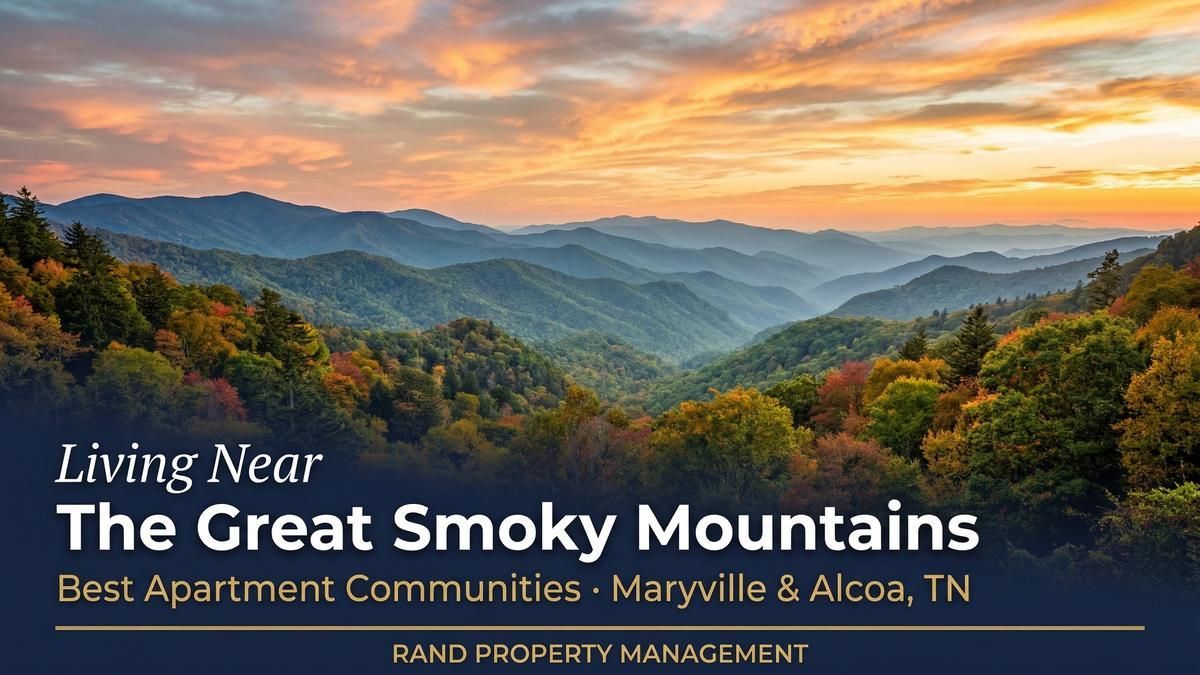
Maryville and Alcoa sit at the foot of the Great Smoky Mountains — closer to the national park entrance than any other East Tennessee rental market with comparable commercial and employment infrastructure. For renters in these two Blount County cities, the mountains are not a weekend destination that requires planning and effort to access. They are a visible, present, and daily feature of the residential environment — shaping the view from apartment windows, the options available on a free afternoon, the community culture that defines Blount County’s identity, and the specific quality of life that renters who choose this area consistently describe as the primary reason they stay.
Rand Property Management’s Park Place communities in Maryville and Rand at Green Meadows in Alcoa give renters access to this mountain-adjacent lifestyle at competitive Blount County price points, with the professional management and pet-friendly community standards that make the outdoor-oriented life these locations support genuinely sustainable on a daily basis.
There is a specific moment that most renters who move to Maryville or Alcoa describe in approximately the same way. It happens within the first week of the move, before the boxes are fully unpacked and before the new address has settled into routine. They are driving somewhere ordinary — to the grocery store, to work, to a restaurant — and the mountains come into view. Not the way mountains appear when you drive toward them on a trip, with the conscious awareness that you are traveling toward a destination. But casually, incidentally, through the windshield on a Tuesday afternoon errand. The blue-gray ridgeline of the Smokies, close enough to read the tree line, rising above the Blount County valley floor in a way that announces itself without warning.
Most people stop noticing it after a few months. But they notice that they stop noticing — which is itself a kind of measure of how completely the mountains have become part of the daily environment rather than a feature of it. And when they leave — for a trip, for a relocation, for a weekend somewhere flat — they notice the mountains’ absence in a way that confirms what their presence had been doing all along.
This guide is about that effect. How the Great Smoky Mountains actually change daily life for renters in Maryville and Alcoa — practically, aesthetically, recreationally, and in the quieter ways that a natural landscape shapes a community over time without anyone planning for it.
The Geography: Why Maryville and Alcoa Are Different From the Rest of East Tennessee
East Tennessee is a mountain-adjacent region in a general sense — the Appalachian chain defines the region’s eastern boundary and is visible from most of the Tennessee Valley on a clear day. But Maryville and Alcoa occupy a specific geographic position that distinguishes them from Knoxville, Morristown, Jefferson City, and the other East Tennessee markets where Rand Property Management operates.
Blount County sits at the base of the Great Smoky Mountains in a way that the other East Tennessee markets do not. Where Knoxville is separated from the mountains by approximately 45 miles and several ridgelines, Maryville and Alcoa are separated from the Great Smoky Mountains National Park entrance by approximately 15 miles and a single valley.
The mountains that are a backdrop in Knoxville are a foreground in Maryville.
This geographic position produces several specific conditions that shape the Maryville and Alcoa residential experience in ways that are not available in other East Tennessee markets regardless of price.
The air quality in Blount County benefits from the mountain positioning — the prevailing winds that move through the Great Smoky Mountains carry cleaner, cooler air into the Maryville and Alcoa valley than the more urbanized Knox County airshed receives. The atmospheric clarity on clear days in Blount County — the visible sharpness of the ridgeline, the color differentiation between the near hills and the distant peaks — is noticeably greater than in Knoxville’s more industrialized air environment.
The temperature profile of Maryville and Alcoa is meaningfully cooler in summer than Knoxville’s, despite the two cities being separated by only 15 miles. The mountain positioning creates a valley microclimate in which cool air drains from the higher elevations during evenings and nights, producing morning temperatures and overnight lows that routinely run 5 to 8 degrees below Knoxville’s equivalent readings during summer. For renters who live in apartments and rely on HVAC systems to manage summer heat, the cooler Blount County baseline translates directly into lower utility costs and a more comfortable outdoor environment during the hottest months.
The rainfall distribution in Blount County reflects the mountains’ orographic effect — the Smokies catch a significant portion of the precipitation that moves through the region, and the valley below receives the moisture that filters through the forest canopy rather than the full force of weather systems. The result is a landscape that is consistently greener, more richly vegetated, and more visually lush than the more exposed valley floor environments further north and west in the Tennessee Valley.
Proximity That Changes the Calculation: 30 Minutes to the Park
The Great Smoky Mountains National Park entrance from most Maryville addresses is approximately 30 minutes. From Alcoa, the drive is similar — 25 to 35 minutes depending on traffic and specific destination within the park. This proximity number sounds simple, but its effect on residential behavior is not simple at all.
The difference between a 30-minute drive and a 45-minute drive to a natural destination is not 15 minutes. It is the difference between a destination you use spontaneously and one you use by appointment. A 45-minute drive to the Smoky Mountains from Knoxville requires a certain level of intentionality — you go when you plan to go, for a meaningful portion of a day, because the time investment justifies the decision. A 30-minute drive from Maryville or Alcoa crosses the threshold where the park becomes genuinely casual — where the decision to go for a hike can be made at 9 AM on a Saturday without any planning overhead, where the park is an option for a free afternoon in the same way that a neighborhood park is an option for a city-dweller.
This behavioral shift — from planned destination to spontaneous option — changes what the park means to a resident’s life. It is no longer a recreation resource you use on designated recreation days. It becomes part of the ambient possibility of daily life in the way that a great neighborhood coffee shop becomes — available when you want it, there when you don’t, and quietly shaping the quality of the environment by its presence even when you don’t actively use it.
For renters with dogs — and Rand’s Park Place communities in Maryville and Rand at Green Meadows in Alcoa are pet-friendly communities with puppy stations throughout — the 30-minute park proximity means the leashed-pet-permitted trails of the Smoky Mountains are a weekly option rather than a special trip. Abrams Creek trail in Cades Cove, the Gatlinburg Trail, the Oconaluftee River Trail — all permit leashed dogs — become the rotation of outdoor options that a Maryville or Alcoa renter with a dog cycles through across the year.
For renters who are serious hikers, the park proximity means something qualitatively different from what it means for casual visitors. The Smokies’ trail system has over 800 miles of maintained trails. A committed hiker could spend years on those trails without repeating a route. For someone who lives 30 minutes away and can hit a different trailhead on any given weekend morning, the park is effectively an infinite recreation resource that never goes stale and never requires the planning overhead that makes outdoor recreation at more distant parks logistically demanding.
Cades Cove: The Feature That No Other East Tennessee Market Has
No discussion of mountain proximity for Maryville and Alcoa renters is complete without specific attention to Cades Cove — because Cades Cove is the feature that most distinguishes proximity to the Smokies from proximity to other Appalachian mountain landscapes, and that most consistently surprises new Blount County residents who did not fully understand what they were moving near.
Cades Cove is an 11-mile loop road through a historic mountain valley enclosed by the surrounding peaks of the national park. It is the most visited single destination in the most visited national park in the United States. The reason is the wildlife. Cades Cove is one of the most reliable large wildlife viewing locations in the eastern United States — white-tailed deer are present in numbers that make seeing them an expectation rather than an event, black bears are regularly sighted in the cove’s fields and forest margins, coyotes, wild turkeys, and a range of smaller wildlife round out a viewing experience that competing parks charge significant premiums to approximate.
For Maryville and Alcoa renters, Cades Cove is a 35 to 45 minute drive. The cove opens at sunrise and closes at sunset. A sunrise drive through Cades Cove — watching the mist clear from the valley floor while deer graze in the meadows and the surrounding peaks catch the first light — is the kind of experience that outdoor destination resorts charge hundreds of dollars per night to place guests within reach of. For residents of Rand’s Park Place communities in Maryville, it is a Tuesday morning option when the week’s schedule allows an early start.
The cove is also historically significant — the preserved 19th century homesteads, grist mills, and churches of the original Cades Cove settlement give the valley a cultural depth that pure natural scenery alone does not provide. For renters who are interested in Appalachian history and the specific story of the mountain communities that preceded the park’s establishment, the cove is an outdoor education as much as a recreation destination.
The Foothills Parkway: Your Daily Scenic Drive
The Foothills Parkway is a scenic highway that runs along the northern boundary of the Great Smoky Mountains National Park, offering elevated views of the surrounding mountain landscape from a series of overlooks that most national park visitors never find. The parkway’s western section — the portion that is most accessible from Maryville and Alcoa — offers some of the most expansive views in East Tennessee, looking south into the park and north across the Blount County valley that Maryville and Alcoa occupy.
For renters in these two cities, the Foothills Parkway is the scenic drive that is available after any dinner, on any clear evening, without a map or a plan. It is not a wilderness experience — it is a paved road accessible to any vehicle — but the views it provides are genuinely extraordinary and genuinely proximate. The sunset from the Look Rock observation tower at the western end of the parkway’s accessible section is the kind of experience that photographers plan trips to capture. For Maryville and Alcoa residents, it is a 25-minute drive on a Wednesday evening when the sky looks promising.
The parkway’s accessibility also makes it available to residents who are not hikers or campers — who enjoy natural landscapes from the perspective of a scenic drive rather than a trail. East Tennessee’s outdoor culture is broad enough to include this access mode, and the Foothills Parkway is the specific infrastructure that makes mountain landscape access genuinely universal rather than limited to physically active residents.
How the Mountains Shape the Seasons for Blount County Renters
The Great Smoky Mountains do not simply provide a view. They organize the seasonal experience of living in Blount County in ways that are more defined and more celebrated than in any other East Tennessee residential market.
Spring
Spring in Maryville and Alcoa is one of the natural world’s more dramatic performances, and it unfolds over a period of weeks rather than days because the mountains’ elevation gradient means the season progresses upward from the valley floor to the high peaks over time. The wildflower bloom in the Smoky Mountains — 1,500 species of flowering plants, more than any other area of comparable size in North America — begins at lower elevations in late March and moves progressively upward through April and into May. Residents who visit the park in the valley in early April and in the upper elevations in late April are watching two different phases of the same seasonal event.
The trillium display in the Smokies — one of the most celebrated wildflower events in Appalachia — occurs in April and is accessible via multiple trails within 30 minutes of Maryville and Alcoa. For renters who have not previously lived near the Smokies, the wildflower spring is one of the most consistently noted revelations of the first year in Blount County.
Summer
Summer in Maryville and Alcoa is shaped by the mountains’ cooling influence in the ways described earlier — the valley microclimate, the evening air drainage, the 5 to 8 degree temperature advantage over Knoxville. Practically, this means Blount County summers are genuinely more comfortable for outdoor activity than the Tennessee Valley communities further north, and that the mountain streams — cold, fast, and accessible within 30 minutes — provide a specific summer recreation option that no urban amenity can replicate.
The swimming holes and wading pools of the Smokies’ mountain streams — Abrams Creek, the Little River, the Oconaluftee — are summer destinations that Maryville and Alcoa residents treat as neighborhood amenities. The cold, clear water of mountain streams fed by the high-elevation snowmelt and spring systems of the Smokies maintains temperatures in the 55 to 65 degree range through summer — providing natural cooling that the most elaborate apartment pool cannot approach in terms of the physiological and psychological experience of immersion in cold, clean mountain water.
Fall
Fall is the season that most completely defines what it means to live near the Great Smoky Mountains — and for Maryville and Alcoa renters, it is the season that most frequently converts a planned short-term tenancy into a longer-term residential commitment.
The Smoky Mountains’ fall color display is the most celebrated in the eastern United States.
The combination of the park’s extraordinary tree diversity — over 100 native species of trees, producing a color range from the deep crimson of sourwoods to the yellow of tulip poplars to the orange of maples — with the elevation gradient that extends the season from mid-September at the highest peaks to mid-November in the lower valleys produces a display that is simultaneously more colorful, more varied, and longer than fall foliage events in any other eastern mountain range.
For Blount County renters, this means that the peak of fall color is not a single weekend to be scheduled and protected in the calendar. It is a six-week season in which the color changes visibly week to week and the specific character of the display on any given day is unrepeatable. A drive to the park in the first week of October reveals one landscape. The same drive three weeks later reveals something entirely different. Residents who live 30 minutes from this display and can access it on any afternoon or weekend morning experience fall in a way that is simply not available to anyone who must travel to see it.
The effect on the residential environment in Maryville and Alcoa is tangible even without entering the park. The Blount County landscape itself — the surrounding hills that frame the valley, the tree-lined residential streets of Maryville’s historic neighborhoods, the agricultural and natural landscapes that buffer the urban core from the park — participates in the fall color event at a smaller scale that makes the entire residential environment feel transformed during the peak weeks.
Winter
Winter in Maryville and Alcoa is the season that most surprises renters who did not fully understand the mountains’ role in defining the regional climate. The Smoky Mountains receive significant snowfall at higher elevations — Newfound Gap, at 5,046 feet elevation, receives an average of 69 inches of snow annually — while the valley communities at the base remain in the moderate temperature range that defines the Tennessee Valley’s mild winters.
The practical result for Maryville and Alcoa renters is access to snow and winter mountain landscapes within 45 minutes of home without living in the snow zone themselves. A Sunday morning drive to the high elevations of the Smokies for a snow hike or simply for the landscape experience of a snow-covered mountain forest is available from a Blount County apartment from December through February in most years, without the logistical overhead of a mountain winter as a residential reality.
The valley itself experiences enough winter precipitation events — occasional snow and more common ice — to provide seasonal definition without the severity that makes northern winters a quality-of-life detractor. For renters from northern states who relocated for the milder climate, East Tennessee’s winters provide the best available balance: genuine cold and occasional snow for those who value seasonal definition, without the sustained severity that makes northern winters costly, dangerous, and exhausting.
The Cultural Effect: How the Mountains Shape Blount County’s Community
The Great Smoky Mountains don’t just affect outdoor recreation for Maryville and Alcoa renters. They shape the community culture of Blount County in ways that distinguish it from Tennessee Valley communities that are geographically and economically similar but lack the mountain presence.
Blount County’s outdoor culture is both cause and effect of the mountain proximity — a cycle in which the park’s presence attracts outdoor-oriented residents, those residents support outdoor-oriented businesses and community events, and the community character that results attracts more outdoor-oriented residents in turn. The specific expression of this culture in Maryville and Alcoa includes a density of hiking clubs, trail running groups, cycling communities, kayaking and paddling organizations, fishing clubs, and wildlife photography groups that communities of comparable size in flat-terrain markets simply do not develop.
The farmers market culture in Maryville — with the downtown market that operates through the growing season reflecting the agricultural tradition of the Blount County valley — is rooted in the same regional identity that the mountains anchor. The local food movement in Blount County has genuine depth because the region’s agricultural tradition predates the commercial development that interrupted it in other Tennessee markets, and because the outdoor-oriented community that the mountains attract is also a community that values locally sourced food in disproportionate numbers.
Historic Downtown Maryville’s character — the independent restaurants, the boutique retailers, the community events that fill the downtown calendar through the year — reflects the specific community that mountain proximity has shaped. The first-time visitor to Historic Downtown Maryville who has also visited Gatlinburg — the heavily commercialized tourist gateway to the park — encounters a stark contrast between a town that has organized its identity around tourism and a city that has organized its identity around being a genuine place to live. Maryville is the latter, and the mountains are part of why.
Rand Property Management’s Blount County Communities: The Practical Gateway to Mountain-Adjacent Life
Understanding what the Great Smoky Mountains offer to Maryville and Alcoa renters is one thing. Finding the right community from which to access that life is another. Rand Property Management’s Blount County communities are specifically positioned to provide both.
Park Place West and Park Place South in Maryville give residents the proximity to Historic Downtown Maryville, DENSO Manufacturing, Maryville College, Hunter’s Crossing, and Foothills Mall that makes the city’s daily life functional and convenient — while the 30-minute drive to the Smoky Mountains from these addresses makes the park’s entire offering part of the residential routine. The pet-friendly policies at Park Place, with puppy stations throughout both communities, mean that a dog owner’s Smoky Mountain hiking schedule is supported from home rather than complicated by it.
Rand at Green Meadows in Alcoa positions residents at the airport-adjacent Blount County location that provides efficient access to McGhee Tyson Airport alongside the same mountain proximity that Maryville’s Park Place communities offer. For renters whose professional lives involve regular air travel and whose personal lives involve regular outdoor recreation, the Rand at Green Meadows position — airport minutes away, national park 30 minutes away — is a residential efficiency that no other East Tennessee rental community can replicate.
Both communities include 24/7 emergency maintenance, on-site parking, professional leasing teams, and the community management quality that makes living in these locations sustainable as a daily experience rather than aspirational as a marketing claim. The mountains are the backdrop. Rand’s management is the operational foundation that makes the daily reality match the promise.
Contact the Rand leasing team or visit randpropertymanagement.com/community-directory to find current availability at Park Place West, Park Place South, and Rand at Green Meadows in Blount County.
Frequently Asked Questions — Living Near the Smoky Mountains in Maryville and Alcoa
How far is Maryville, TN from the Great Smoky Mountains National Park?
Most Maryville addresses are approximately 25 to 35 minutes from the Great Smoky Mountains National Park entrance at the Townsend gateway or the Gatlinburg approach. The Townsend entrance — which accesses the Cades Cove loop road and the western park trail system — is typically the closest park entrance for Blount County residents and is accessible via US-321 through Maryville without requiring interstate travel.
How far is Alcoa, TN from the Smoky Mountains?
Alcoa’s proximity to the Smoky Mountains is comparable to Maryville’s — approximately 25 to 40 minutes to the nearest park entrances depending on the specific destination within the park. The two cities share the Blount County valley position at the base of the mountains that gives both their mountain-adjacent residential character.
Is it possible to hike in the Smoky Mountains and return home the same day from Maryville?
Yes — and the proximity makes day hiking from a Maryville or Alcoa apartment genuinely casual rather than logistically demanding. Most park trails accessible from the Townsend and Gatlinburg entrances are day-hike length. A Maryville resident can begin a hike at 8 AM, complete a 6 to 10 mile trail, and be home by early afternoon — a routine that requires no overnight planning, no extended travel, and no significant scheduling coordination.
Does the proximity to the Smoky Mountains affect rent prices in Maryville and Alcoa?
Mountain proximity is one of multiple factors that shape Blount County rent levels — alongside employment access, commercial infrastructure, and overall demand. Maryville and Alcoa rents run slightly below comparable Knoxville configurations — typically $75 to $150 per month less for equivalent bedroom counts — while offering superior mountain access.
The combination of lower rent and greater mountain proximity than Knoxville makes Blount
County arguably the highest value-per-dollar rental market in East Tennessee for outdoor-oriented renters.
Are pets allowed on trails in the Great Smoky Mountains National Park?
Pets are permitted on a limited number of trails within the Great Smoky Mountains National Park, all of which require leashed dogs. The Gatlinburg Trail, Oconaluftee River Trail, and Abrams Creek Campground trail are among the pet-permitted routes. Pets are not permitted on most backcountry trails within the park but are welcome at campgrounds, picnic areas, and along roadsides. The Foothills Parkway is fully accessible to leashed pets. Rand’s pet-friendly Blount County communities — Park Place and Rand at Green Meadows — are specifically suited to dog owners whose outdoor lifestyle includes regular Smoky Mountain access.
What is Cades Cove and why do Maryville renters visit it regularly?
Cades Cove is an 11-mile loop road through a historic mountain valley within the Great Smoky Mountains National Park, accessible approximately 35 to 45 minutes from Maryville. It is the most visited single destination in the national park system and is known for reliable wildlife viewing — white-tailed deer, black bears, wild turkeys, and coyotes are regularly observed. The cove also contains preserved 19th century homesteads, churches, and a grist mill that provide historical context alongside the wildlife experience. For Maryville and Alcoa renters, Cades Cove is accessible as a sunrise drive on a weekday morning or a weekend afternoon outing without overnight planning.